
Legal help, services and support for private residential landlords
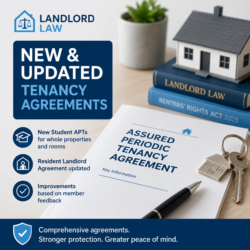 The new Landlord Law Assured Periodic Tenancies (APTs) were launched at towards the end of May after an intensive development and drafting process. I discussed them in my previous post here.
The Student APTs
I have since launched two student APTs, one for a whole property and one for a room in a shared house. These differ from the standard APTs in a number of ways:
- They include a Ground 4A notice
- They include a declaration confirming that all tenants satisfy the student test
- They include provisions dealing with HMO management obligations and tenant cooperation, and
- They include a short-form guarantee
We have not included an in-tenancy guarantee with the standard APTs as we prefer members to use the standalone guarantee for the reasons discussed in my earlier post.
However, student tenancies are unlikely to last long enough for landlords to need to increase the rent, so the problems resulting from this are unlikely to occur.
The Resident Landlord Agreement
I also re-drafted our tenancy agreement for a resident landlord.
This is not an APT, and so the rules brought in by the Renters’ Rights Act do not apply where the landlord is renting self-contained accommodation in the same building they live in (Housing Act 1988 Schedule 1 (10)) .
However, I liked the introduction of a Key Information section, which I think is really helpful for tenants, so this is now included in the resident landlord agreement.
Along with some of the other changes, such as the new way of dealing with the payment of bills and provision for landlords using alternative deposit schemes.
Updating the standard APTs
I am grateful to those members who provided feedback on the new APTs.
Partly as a result of this, I have now done a few tweaks to the new agreements, including
- Requiring tenants to notify landlords if they receive or stop receiving Universal Credit (in view of the changes to the possession ground 8).
- A better way of dealing with the tenants’ email addresses (which several members have asked about), and
- Giving landlords a choice whether the tenancy is signed as a deed at the end or not.
The other amendments are set out in the changelog page.
And finally
The Landlord Law tenancy agreements are one of the reasons why our members stay with us so long.
Although the new agreements are longer than before, this is largely due to the statutory Key Information requirements and the additional clauses needed to protect landlords under the new legal regime.
Many landlords understandably prefer a shorter tenancy agreement, but brevity can come at a price. The problem with a shorter tenancy agreement is that it is more likely to have omitted clauses which are required or which protect the landlord’s position.
Landlords need to ensure compliance with all the new rules to avoid the considerably more expensive penalties that can be charged by Local Authorities.
Members can access all current tenancy agreements, together with guidance notes and the full changelog, via the tenancy agreement section of the Landlord Law website.




Footer

 Tessa Shepperson of Landlord Law is an accredited trainer with the
Property Investors Bureau.
Associated website: